
How to Search Cases by Name
Kansas CaseSearch is the statewide public search for Washington County District Court cases. Choose District, select Party Name, Business Name, or Party As Business Name, enter the required term, and set County to Washington. A broad name can produce several people or entities. Match the case type, filing date, party role, and court before relying on a result. The portal is a finding tool, not permission to compile lists about private people.
- Accept the portal terms and select District as the court.
- Choose the search type that fits a person or business and enter the known term.
- Select Washington County, then narrow by case type or filing date when useful.
- Open the likely match and compare its public details with the source document or clerk record.
| Field Label | Type | Required | Notes |
|---|---|---|---|
| Court | Selector | Yes | Choose District for a Washington County trial case. |
| Search Type and Term | Selector and text | Yes | Party, business, case number, or citation number. |
| County | Selector | Recommended | Washington is value 121260 and acronym WS. |
| Additional Filters | Selectors and dates | No | Case type, DOB, and filing dates narrow results. |
Washington County CaseSearch Controls
The current interface includes Accept and Decline, a human check, Search, and Reset. Registration and ID.me sign-in are visible, but basic public details use guest access. Expanded access is limited to approved roles. A blocked human check or no result does not establish that a Washington County case does not exist.
The official CaseSearch interface shows the search route without using a private record.
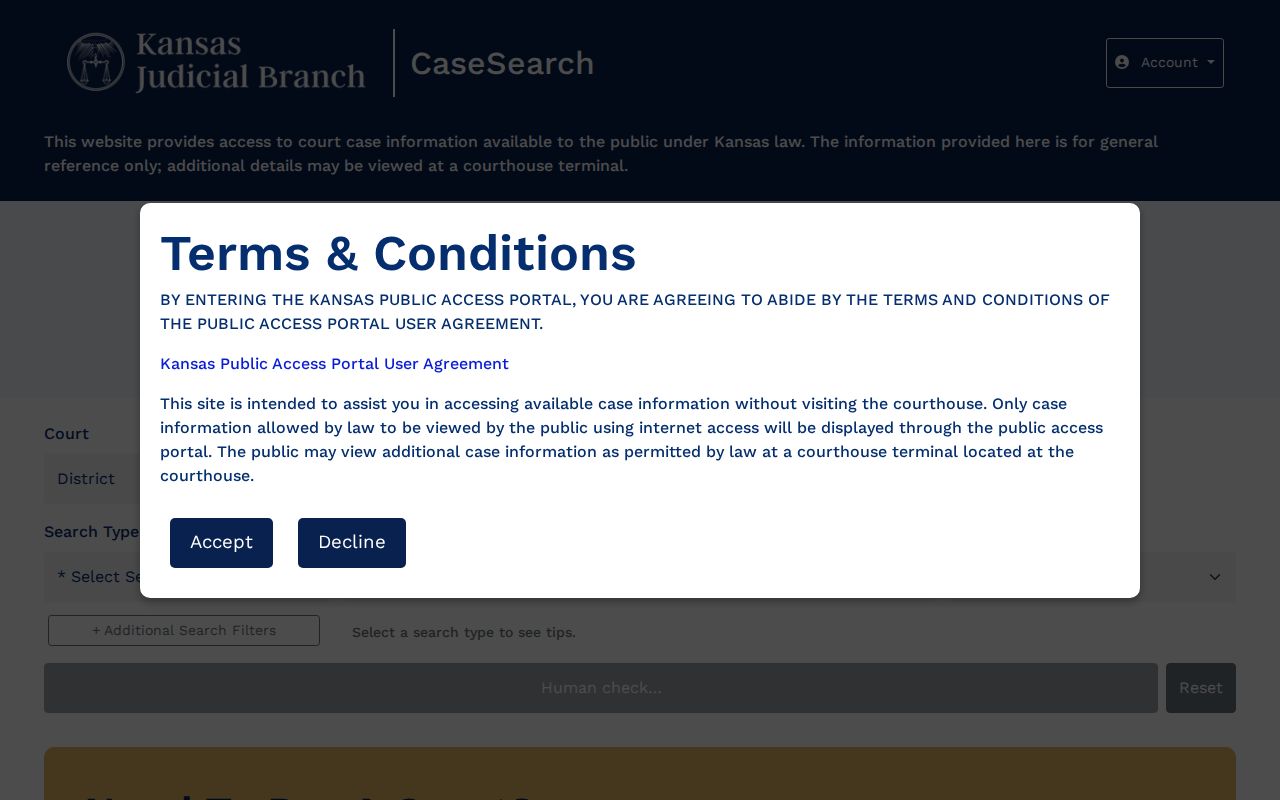
The selected court, search type, search term, and Washington County filter determine the public results.
How to Search by Case Number
An exact number is the most precise Washington County case lookup key. It may appear on a citation, notice, filed paper, order, or receipt. Select Case Number and enter the identifier as printed. Kansas numbers commonly contain a filing year, case-type code, and sequence, but no single Washington display format was confirmed. A privacy-safe structural example is YYYY-XX-#####. Do not guess missing digits. Older or migrated records may use another pattern, so use a name search or call the clerk if the printed number fails.
Washington Courthouse Search Fallback
The Kansas district-records explanation says every courthouse has a public computer for permitted case and record searches. The Washington County terminal may show public material missing online. Its exact room, printing options, and terminal charges were not published.
The courthouse is at 214 C Street, Washington, KS 66968. District hours are Monday through Friday, 8 a.m. to noon and 1 to 5 p.m. The clerk directory lists 785-325-2381; the district page lists 785-325-3265. Call before travel when a specific service matters.
The official terminal-access source above shows why online and courthouse searches remain separate.
This fallback is useful when CaseSearch identifies an event but offers no public document.
What a Case Search Shows
A Washington County result can provide case information and an events index. The events index, also called a Register of Actions in Kansas materials, is a dated list of activity, not the full file. A filing label may appear even when the pleading, exhibit, transcript, or signed order cannot be opened online.
| Case Number | The identifier used to return to the same matter. |
|---|---|
| Style / Parties | Public names, caption, and roles, subject to restriction. |
| Case Type | Criminal, civil, family, probate, or mental-health category. |
| Events and Hearings | Dated activity and public settings when available. |
| Documents | Public links or an access-limit message. |
Washington CaseSearch Access Limits
CaseSearch says its display is not the official court record. The public portal agreement controls online use. A missing PDF may reflect restriction, redaction, court order, migration timing, or a difference between internet and terminal access. It is not proof that the filing never existed.
The agreement is visible in the research capture below.
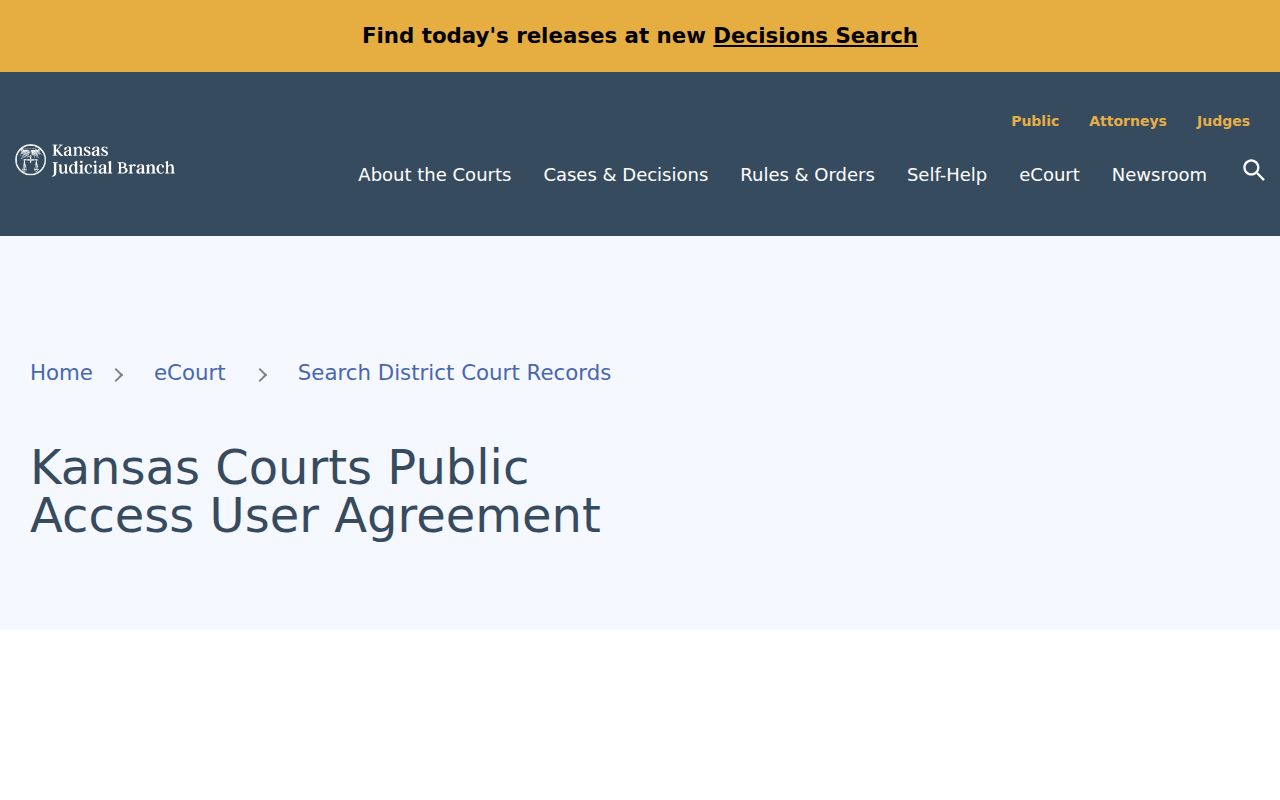
Use a portal result as a finding aid, then ask the clerk for an official or complete record.
County vs Statewide Case Search
Washington County has no separate county case-search database. Kansas CaseSearch is both the statewide starting point and the online Washington County route. Local access means the courthouse terminal, District Court Clerk, and written records request. Each reaches a different depth.
| Channel | Best Use |
|---|---|
| Kansas CaseSearch | Name, number, citation, event, and hearing lookup statewide. |
| Washington courthouse terminal | A permitted public record missing from internet access. |
| District Court Clerk | Specific documents, official copies, and file questions. |
Washington Cases Outside District Court
City ordinance matters stay with the issuing municipal court and city clerk. Washington City Hall has a municipal route, and Hanover has an official municipal-court framework. Current routes for Clifton, Linn, and Greenleaf should be confirmed with the city office rather than assumed from CaseSearch.
A federal matter belongs in District of Kansas systems. PACER and federal CM/ECF are separate from the state portal. Kansas Judicial Branch eFlex is also separate: it is an authorized filing system, not a public Washington County case lookup.
When a Washington Case Is Missing
Recheck the court, spelling, number, and Washington County filter. Then try the courthouse terminal or call the proper clerk. A recent filing may not yet appear, an older matter may use another identifier, and a city or federal case belongs elsewhere. Sealing and other rules can suppress part or all of a public-facing result.
Missing is not dismissed: No online match can reflect routing, timing, search input, or an access limit. Confirm with the originating court.
For a district matter, the local fallback is Aaron Debes, District Court Clerk. The county directory gives 214 C Street and 785-325-2381, while the district page also publishes P.O. Box 235 and 785-325-3265. The two official contact pairs are not identical. Confirm the correct line before mailing a request or faxing any record form.
Restricted Cases and Access Rules
Kansas Supreme Court Rule 22 governs electronic access. Juvenile files, sealed matters, protected data, and some family, parentage, custody, guardianship, probate, or mental-health material may be restricted. A public case can still contain nonpublic documents.
K.S.A. 45-221 recognizes disclosure exceptions, and K.S.A. 60-2617 supplies a good-cause framework for sealing or redaction. Restricted access is not obtained by registration. A person with a lawful case-specific basis should ask the District Court Clerk about the proper request or court-order route.
When a public result exists but a needed document does not open, identify the exact event date and document label. That narrow description helps the clerk locate the item and determine whether a public copy can be released. A request for every record tied to a common name is less useful and may exceed the access and compilation rules.
Reading Washington County Case Events
A Washington County events index should be read in date order. Filing labels record that an action occurred, but they do not always state the legal effect or provide the document. A hearing setting is not a final outcome. A continuance moves a setting; it does not dismiss the case. An order or judgment entry points to a ruling, yet the signed document remains the best source for its terms. Status words such as open, pending, disposed, or closed describe the case's current administrative posture and should not be expanded beyond what the record says.
- Events index
- The dated list of public case activity used as a finding aid.
- Setting
- A scheduled court event, not necessarily a trial or disposition.
- Disposition
- A recorded outcome whose exact effect should be checked against the judgment or order.
- Restricted document
- An item whose image or contents are unavailable through the public channel.
For a current court date, compare the event list with the statewide hearing calendar and the latest court notice. The originating clerk is the right source when those records conflict.